

Thinking about a distance MBA course but not sure what you will actually study? Before signing up, most people want answers to three simple questions: Which subjects will I learn? How is the syllabus split across semesters? And how long will it take to finish?
This guide answers all three in plain words. You will see the core subjects every student studies, a full semester-by-semester syllabus. You will learn how study works day to day, from books and classes to assignments and exams.
What Is a Distance MBA Course?
A distance MBA is a two-year master’s degree in business management that you study mostly on your own, away from the campus.
So what does a distance MBA mean in simple words? It means you do not attend daily classes. The university gives you study material, runs a few guidance sessions, and holds exams. The rest of the learning happens at your own pace.
You learn the same main business areas as any MBA student: managing people, money, marketing, and day-to-day operations. What changes is how you learn, not what you learn. If you want to explore this study format further, see UpskillX’s distance MBA programmes.
How Many Years Does a Distance MBA Take to Complete?
A distance MBA takes at least 2 years, split into 4 semesters. You cannot finish it faster.
But most universities give you extra time, because many students work while they study. For example:
- IGNOU: minimum 2 years, maximum 4 years
- Jamia Millia Islamia (distance mode): minimum 4 semesters (2 years), maximum 8 semesters (4 years)
- NMIMS: 2 years, split into 4 semesters
UGC’s 2020 rules for distance and online courses cap the maximum time at double the minimum time. So a 2-year distance MBA usually cannot stretch beyond 4 years.
What if you fail in any subject?
You can usually clear pending subjects in a later exam round, as long as you finish within the maximum time. Many universities hold exams more than once a year. IGNOU, for example, holds them in June and December, so you get regular chances.
Example: Riya works in a bank. In her first semester, she passed 5 of her 7 subjects. She can write the other 2 in the next exam round and still move ahead with her course.
Always check your own university’s rules, because the maximum time can differ. Students exploring different MBA learning formats can also compare a one-year online MBA with a distance MBA to understand the differences in course duration, eligibility and structure.
What Subjects Do You Study in a Distance MBA?
The subjects in a distance learning MBA fall into three groups.
Core Subjects (First Year)
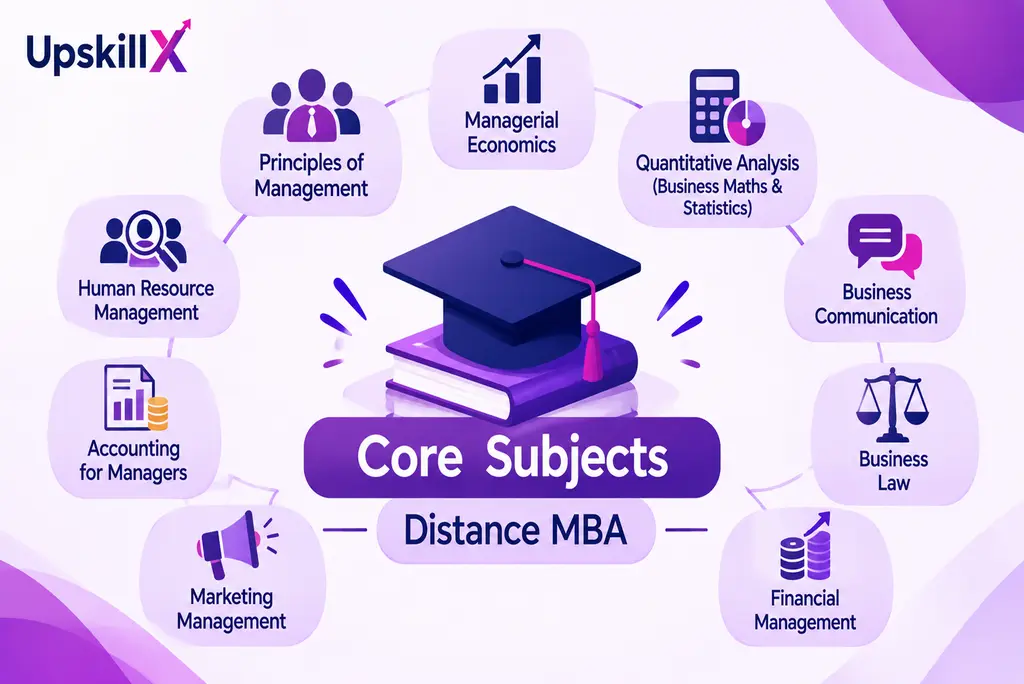
Every student studies these, whatever specialisation they pick later. They teach the basics of running a business. Common core subjects include:
- Principles of management
- Human resource management
- Accounting for managers
- Marketing management
- Managerial economics
- Quantitative analysis (business maths and statistics)
- Business communication
- Business law
- Financial management
Elective Subjects (Second Year)
In the second year, you study subjects linked to your chosen specialisation. These are called electives. For example, a finance student may study working capital and share-market investing. A marketing student may study consumer behaviour and sales.
Project or Dissertation
Most distance MBA courses ask you to do a project. You pick a real business problem, research it, and write a report.
The rules differ by university. At IGNOU, the project is worth 8 credits, the same as two normal subjects, and your project plan (called a synopsis) must be approved before you start. At NMIMS, the project comes in the last semester, and your report must cover your goals, research method, findings, and suggestions.
What Is the Semester-Wise Syllabus for a Distance MBA?
Most distance MBA courses follow the same plan:
- Semesters 1 and 2: core subjects that every student studies
- Semesters 3 and 4: specialisation subjects, plus the project
But each university fills these semesters in its own way. Here is how two well-known universities compare. One is a government open university (IGNOU), and the other is a private university (NMIMS). For NMIMS, we show the Finance specialisation as an example.
| Semester | IGNOU | NMIMS (Finance) |
| Semester 1 | Management Functions and Organisational Processes, Human Resource Management, Business Environment, Accounting for Managers, Quantitative Analysis for Managerial Applications, Marketing Management, Business Communication | Business Economics, Financial Accounting and Analysis, Information Systems for Managers, Management Theory and Practice , Organisational Behaviour |
| Semester 2 | Information Systems for Managers, Management of Machines and Materials, Managerial Economics, Social Processes and Behavioural Issues, Strategic Management, Business Laws, Financial Management | Includes Business Communication, Business Law, Decision Science |
| Semester 3 | Research Methodology, International Business Management, Project Course, 4 specialisation subjects | Capital Market and Portfolio Management, Cost and Management Accounting, Corporate Finance, Marketing of Financial Services, Strategic Cost Management, Taxation |
| Semester 4 | Advanced Strategic Management, Entrepreneurship, Total Quality Management, Business Ethics and CSR, 3 specialisation subjects | Business Ethics, Governance and Risk, Financial Institutions and Markets, International Finance, Research Methodology, Strategic Financial Management, Project |
What this table tells you:
- Both start with the basics. Accounting, economics, people management and communication come first at both universities.
- The order can change. IGNOU teaches Business Communication in Semester 1, while NMIMS teaches it in Semester 2.
- The second year is where they differ most. IGNOU keeps some common subjects for everyone, like Entrepreneurship and Total Quality Management. At NMIMS, almost the whole second year depends on your specialisation.
The size of the course can differ too. IGNOU’s MBA has 28 courses worth 116 credits in total. (A credit shows how much study a subject needs.) Shivaji University’s distance MBA is counted in marks instead: 3,200 marks in all, with each paper worth 100 marks.
Syllabi change often, so always download your university’s latest syllabus before you enrol.
What Specialisations Can You Choose in a Distance MBA?
A specialisation is the business area you focus on in your second year. It decides most of your elective subjects.
Across Indian universities, you can find around 18 distance MBA specialisations. No single university offers all of them, so check your university’s list before you apply.
Core Specialisations (Offered by Most Universities)
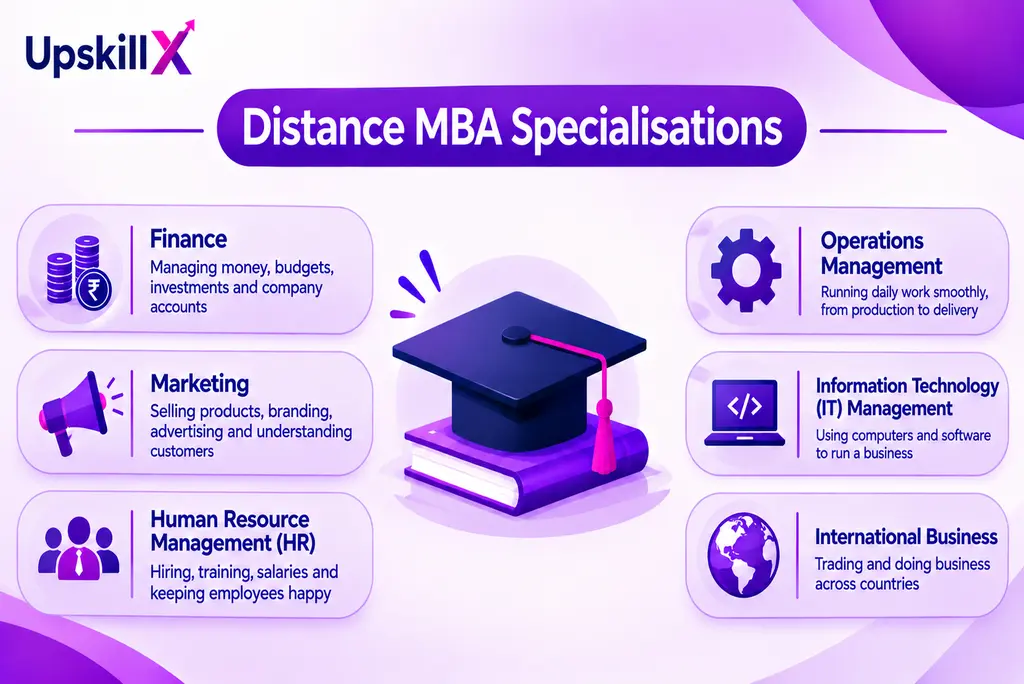
These six are the most common. Almost every distance MBA offers most of them.
| Specialisation | What you learn |
| Finance | Managing money, budgets, investments and company accounts |
| Marketing | Selling products, branding, advertising and understanding customers |
| Human Resource Management (HR) | Hiring, training, salaries and keeping employees happy |
| Operations Management | Running daily work smoothly, from production to delivery |
| Information Technology (IT) Management | Using computers and software to run a business |
| International Business | Trading and doing business across countries |
Other Specialisations (Offered by Fewer Universities)
These twelve are more specific. Only some universities offer them.
| Specialisation | What you learn |
| Business Analytics | Using data to make better business decisions |
| Data Science | Studying large amounts of data to find useful patterns |
| Digital Marketing | Selling online through social media, search engines, and email |
| Logistics and Supply Chain Management | Moving goods from the maker to the buyer on time |
| Banking and Finance | How banks work, loans and financial services |
| Healthcare and Hospital Management | Running hospitals, clinics and health services |
| Retail Management | Running shops, stores and shopping chains |
| Services Management | Managing service businesses such as banks, insurance and retail |
| Project Management | Planning projects and finishing them on time and within budget |
| Entrepreneurship | Starting and growing your own business |
| Tourism and Hospitality Management | Running hotels, travel and tourism businesses |
| Agribusiness Management | Managing farming and food businesses |
Two real examples:
- IGNOU offers Financial, Marketing, HR, Operations and Services Management in its main MBA. It also runs separate distance MBA programmes in Banking and Finance, Healthcare and Hospital Management, and Logistics and Supply Chain Management.
- NMIMS offers seven: Business Management, Operations and Data Sciences Management, Financial Management, Marketing Management, Human Resource Management, Information Technology Management, and Business Analytics.
How to choose your specialisation:
- Think about your job. If you already work in sales, marketing can help you grow faster in that role.
- Think about where you want to go. Want to move into finance or HR? Pick the specialisation for that field.
- Read the subject list, not just the name. “Operations” at one university may lean towards supply chain, while at another it may lean towards production.
Before deciding, compare the available MBA courses and university options by curriculum, specialisation, duration, and fees.
Read Also
How Does the Distance MBA Study Model Work?
The study model has three parts: you read on your own, you join guidance sessions, and you prove what you learned through assignments and exams.
Study Materials
The university gives you self-learning material. These are books written so you can understand each topic without a teacher in the room.
The format depends on the university:
- Government open universities like IGNOU give printed books or e-books, split into small parts called blocks. You also get short audio and video lessons, and you can download the material online.
- Private universities like NMIMS mostly use an online student portal. It has e-books, recorded lectures, and discussion forums, and you can open it any time of day.
Classes and Contact Sessions
You do not have daily lectures. Instead, the university runs guidance sessions, often called counselling sessions, where a teacher explains hard topics and answers your questions.
Where these sessions happen depends on the university:
- At study centres: IGNOU holds sessions at study centres, mostly outside normal working hours, so working students can join. It also shares live lessons online.
- Online: Private universities like NMIMS run classes online, with recorded lectures you can watch later, so you can study from anywhere.
Assignments and Exams
Almost every distance MBA marks you in two ways: assignments you do at home and exams at the end of each term. How much each one counts, and how the exams are held, depends on the university.
| IGNOU | NMIMS | |
| Assignments | 30% of your marks (one per subject) | Part of your marks |
| Exams | 70% of your marks, written at an exam centre | Online exams |
| When exams happen | Twice a year, in June and December | Set by the university each term |
At IGNOU, you must submit a subject’s assignment before you can write its exam. Check your own university’s rules early, so you don’t miss a deadline.
Looking for the Right Guidance for Your Future?
At UpskillX, we help students make informed decisions about their education, academic opportunities, and career paths. Get the right guidance and take a confident step towards your future.