

Thinking about an MBA in Finance? This guide covers eligibility, entrance exams, the semester-wise syllabus, fees, colleges, careers and salary in India, for both fresh graduates and working professionals.
What is an MBA in Finance?
An MBA in Finance is a postgraduate degree focused on financial management, investments, banking and related areas. The course teaches you how businesses raise funds, decide where to invest, manage budgets and control financial risks.
At many colleges, Finance is offered as a specialisation or a set of electives within a general MBA programme rather than as a separate degree. Some universities offer a standalone MBA in Finance.
MBA in Finance course details
You can study this course in three formats. The right one depends on your career stage.
| Type | Duration | How it works | Best for |
| Full-time | Two years, four semesters | On campus, with an internship and campus hiring | Fresh graduates |
| Online | Two years, with extra time allowed at many universities | Live and recorded classes from home | Working professionals |
| Executive | One to two years, depending on the institute | Full-time, evening or weekend classes | Professionals with several years of work experience |
Executive MBA programmes vary in duration and format. For example, IIM Ahmedabad’s PGPX is a one-year programme, while FMS Delhi’s MBA Executive is a two-year evening programme.
Online vs campus MBA in Finance
For most applicants, the main choice is between a campus programme and an online one. The subjects are largely the same. The admission process, the way you study and the cost are different.
| Campus | Online | |
| Admission | Entrance exam, then group discussion and interview | Often based on graduation marks; some universities hold an aptitude test or interview |
| Classes | In a classroom, on fixed timings | Live and recorded classes you can attend from home |
| Other costs | Hostel, food and relocation | None of these; exam fees are often charged separately |
| Internship | A summer internship in most programmes | Usually not required; many use a project instead |
| Exams | Written exams on campus | Depends on the university: online, computer-based or pen-and-paper at a centre |
| Placements | Companies visit the campus to hire | Placement assistance is available; campus hiring is less common |
| Can you keep your job? | No, it is full time | Yes |
| Degree validity | A regular degree | Valid if offered by a UGC-entitled university |
Choose campus if you can study full time and want campus hiring. Choose online if you need to keep working or want a lower fee.
Check UGC-DEB entitlement first. The Distance Education Bureau (DEB) of the University Grants Commission (UGC) lists the universities and programmes approved for each admission session. Verify both on the UGC-DEB website. Open and distance learning (ODL) programmes must also stay within the university’s permitted territory, and programmes run through franchise centres are not permitted.
You Can Also Read:
MBA in Finance eligibility and admission process
Admission has two requirements: a bachelor’s degree and, for most campus colleges, an entrance exam score.
Who is eligible?
- Degree: a bachelor’s degree of at least three years, in any stream.
- Marks: each college sets its own minimum. Many ask for 50%.
- Final-year students can usually apply.
- Work experience is needed only for executive programmes.
Eligibility for a college is not the same as eligibility for an exam. CAT, for example, has its own rule: 50% marks, or 45% for SC, ST and PwBD (persons with benchmark disabilities) candidates (CAT 2026 eligibility). Meeting the exam rule does not mean you meet every college’s rule.
Some programmes add conditions. Delhi University’s MBA (Finance) needs Maths or Business Maths in Class 12.
Not from commerce? You can still apply. The course covers basic accounting and economics, so graduates from other streams can build the required foundation.
MBA Finance entrance exams
Each group of colleges accepts its own exam. These are the main ones for the 2026-27 admission cycle, with dates from the official exam websites.
| Exam | Accepted by | Date |
| CAT 2026 | IIMs and most top B-schools | 29 November 2026 (iimcat.ac.in) |
| XAT 2027 | XLRI and other XAT colleges | 3 January 2027 (xatonline.in) |
| NMAT 2026 | NMIMS and other private B-schools | 2 November to 20 December 2026 (mba.com) |
| SNAP 2026 | Symbiosis institutes | 13, 19 and 26 December 2026 (snaptest.org) |
| CMAT 2027 | Colleges approved by AICTE (All India Council for Technical Education) | 7 February 2027, as per the National Testing Agency (NTA) exam calendar |
| MAT December 2026 | Many B-schools | 20 December 2026 (paper) and 27 December 2026 (computer). MAT is held four times a year (mat.aima.in) |
| MAH MBA/MMS CET 2027 | Colleges in Maharashtra | Not announced yet (cetcell.mahacet.org) |
Fees, exam dates and admission rules can change. Always check the official college or exam website before applying.
How does admission work?
- Register for the exam your target colleges accept, and take it.
- Apply to each college separately with your score.
- If shortlisted, attend the group discussion, written test and personal interview.
- The college prepares a merit list (a ranked list of selected candidates) from your exam score, academic record, work experience and interview.
- Pay the admission fee and complete document verification to confirm your seat.
MBA in Finance syllabus and subjects
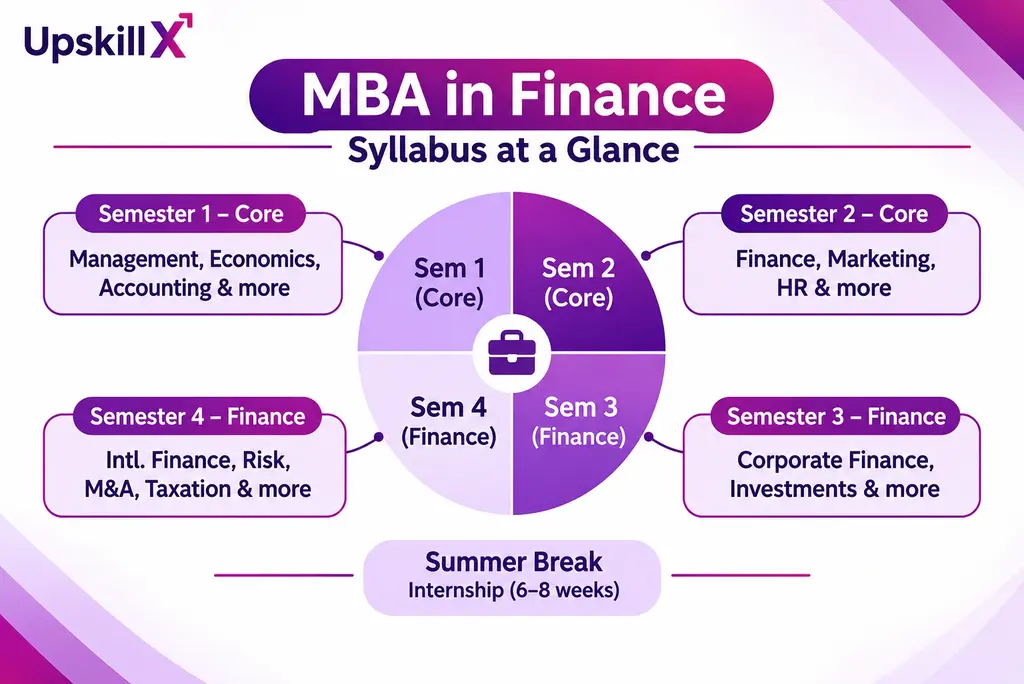
The MBA in Finance syllabus first builds your foundation in management and then moves into finance.
The table below is an indicative MBA Finance syllabus, not any one university’s official list. Subject names, semesters, electives and the internship rule vary by university. Always download the syllabus from the college you plan to join.
| Stage | Subjects |
| Semester 1 (core) | Principles of Management, Managerial Economics, Financial Accounting, Organisational Behaviour, Business Statistics, Business Communication |
| Semester 2 (core) | Financial Management, Marketing Management, Human Resource Management, Operations Management, Research Methodology, Management Information Systems |
| Summer break | Internship of six to eight weeks in most full-time programmes |
| Semester 3 (finance) | Corporate Finance, Security Analysis and Portfolio Management, Financial Markets and Institutions, Financial Derivatives, Strategic Management, one elective |
| Semester 4 (finance) | International Financial Management, Risk Management, Mergers and Acquisitions, Taxation and Tax Planning, one elective, final project |
| Electives to choose from | Investment Banking, Financial Modelling and Valuation, Behavioural Finance, Fintech and Digital Banking, Banking and Insurance Management, Project Finance, Wealth Management, Financial Analytics |
Along with these subjects, you will build practical skills that employers test in interviews:
- Excel, including formulas, pivot tables and charts
- Financial modelling
- Business valuation
- Financial statement analysis
- Financial data analysis
What do the key finance subjects teach?
Some subject names can seem technical. Here is what the five most important ones cover.
| Subject | What you learn |
| Corporate Finance | How a company funds itself and chooses which projects to invest in |
| Portfolio Management | How to select and combine shares, bonds and other assets to balance risk and return |
| Financial Derivatives | How futures and options work and how firms use them to hedge (protect) against price changes |
| Risk Management | How to identify credit, market and operational risk and reduce it |
| Financial Modelling | How to build a financial model of a company in Excel to value it and test decisions |
MBA in Finance fees in India
MBA in Finance fees in India depend mostly on the type of college and on whether you study on campus or online. The gap between the cheapest and costliest options is very wide.
| Type of college | Full fee (approx.) | Notes |
| Government universities | ₹1 lakh to ₹7 lakh (estimate) | University departments and state institutes |
| IIMs | ₹17 lakh to ₹27.5 lakh (estimate) | Fees vary by IIM and programme |
| Top private B-schools | ₹24.86 lakh to ₹30.5 lakh | SPJIMR Mumbai lists ₹24.86 lakh |
| Other private colleges | A few lakh to ₹18 lakh (estimate) | Varies widely by college |
| Online universities | ₹64,000 to ₹2.92 lakh | Chandigarh University Online (₹1.58 lakh to ₹1.8 lakh), Manipal University Jaipur (₹1.84 lakh), Amity Online (₹1.99 lakh to ₹2.07 lakh), MAHE (₹2.92 lakh) |
Rows marked “estimate” are rough ranges, not official figures.
Tuition is not the total cost. Colleges quote fees in different ways:
- IIM Ahmedabad’s ₹27.5 lakh programme fee includes tuition of ₹20.1 lakh; the rest covers other charges.
- SPJIMR’s fee includes tuition and basic hostel.
- Online programmes often charge exam fees separately. NMIMS Online lists ₹800 per subject, per attempt.
Add hostel, food, exam fees and travel before you compare two colleges.
MBA Finance colleges in India
The eight colleges below are well-known options that cover the main routes: government, private and online. This is not a ranking. Note the programme name and how each one offers finance, because only some run a dedicated finance programme.
| College | Programme | How finance is offered | Exam | Total fee (approx.) |
| IIM Ahmedabad | PGP in Management (two-year MBA) | Finance electives within a general management programme | CAT | ₹27.5 lakh for the 2025-27 batch |
| FMS Delhi | MBA (Full Time) | Finance electives within a general MBA | CAT | About ₹2.6 lakh for four semesters (₹65,075 a semester), plus a ₹52,000 yearly student association fee |
| Department of Finance and Business Economics, University of Delhi | MBA (Finance) | A dedicated finance programme | CAT | About ₹1 lakh (estimate) |
| JBIMS Mumbai | MMS (Master of Management Studies) | Specialisation chosen in the second year | MAH MBA/MMS CET | About ₹7 lakh (estimate) |
| XLRI Jamshedpur | PGDM (Business Management) | Finance electives within a general management programme | XAT | About ₹30.5 lakh (₹15.25 lakh a year); mess and hostel extra |
| NMIMS Mumbai | MBA | Finance as an area of specialisation | NMAT | About ₹27 lakh (₹13.5 lakh a year) |
| NMIMS Online | MBA (Online) | Finance specialisation | Based on graduation marks; the university lists no entrance test | ₹1.96 lakh if paid at once; exam fees extra |
| IGNOU | MBA (Online), code MBAOL | Financial Management specialisation | No entrance test | About ₹64,000 (₹15,500 for three semesters and ₹17,500 for one); exam fees extra |
Two notes on the table:
- JBIMS and XLRI do not award an MBA. JBIMS awards an MMS, and XLRI awards a PGDM (Post Graduate Diploma in Management).
- The IGNOU fee is worked out from the per-semester fees in its student handbook. Confirm the current fee on the IGNOU admission portal.
What jobs can you get after an MBA in Finance?
Banks, investment firms, consulting firms, fintech companies and corporate finance teams hire MBA in Finance graduates. Your electives and internships influence which area you enter.
| Job role | Career area | What you do |
| Financial Analyst | Corporate Finance | Study financial data and prepare reports for investment and budget decisions |
| Investment Banker | Investment Banking | Help companies raise capital and advise on mergers and acquisitions |
| Finance Manager | Corporate Finance | Manage budgets, cash flow and financial reporting |
| Risk Manager | Risk Management | Identify financial risks and plan ways to reduce them |
| Credit Analyst | Banking and Credit | Assess whether individuals or businesses can repay loans |
| Portfolio Manager | Wealth Management | Manage investment portfolios for individuals and institutions |
| Fintech Analyst | Fintech and Financial Analytics | Use financial data and technology to support lending, payments and investment decisions |
Many graduates begin in analyst or associate-level positions and move into managerial roles as they gain experience.
Beyond the technical skills listed in the syllabus section, recruiters look for clear written and spoken communication, attention to detail and strong analytical ability.
MBA Finance salary in India
MBA Finance salary in India varies widely by college, role, city and experience.
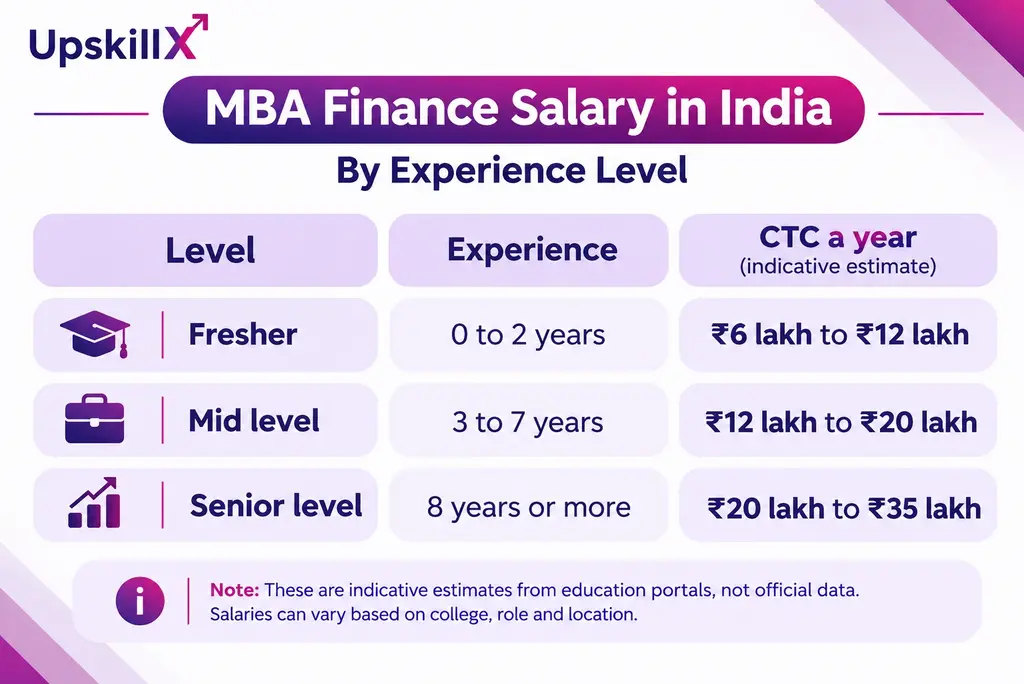
There is no official average for MBA in Finance graduates. The ranges below are indicative estimates drawn from education portals, not official data, so use them only as a rough guide.
| Level | Experience | CTC a year (indicative estimate) |
| Fresher | 0 to 2 years | ₹6 lakh to ₹12 lakh |
| Mid level | 3 to 7 years | ₹12 lakh to ₹20 lakh |
| Senior level | 8 years or more | ₹20 lakh to ₹35 lakh |
CTC is not in-hand salary. CTC (cost to company) is the full yearly package. It can include provident fund, bonuses and other benefits. Your monthly in-hand pay is lower, after these and income tax are deducted.
Top colleges usually report higher packages. For example, FMS Delhi reported an average package of ₹32.27 lakh and a median of ₹29.59 lakh for its 2024-26 batch (placement report). That figure covers the whole batch across all roles, not finance roles alone, and it is one college’s result, not the average MBA Finance salary.
Is an MBA in Finance worth it?
It can be, if the programme builds specialised financial skills and opens better career opportunities than you have today. Its return on investment (ROI), meaning what you gain compared with what you spend, depends on four factors:
- Total cost: a college with lower fees and good placement outcomes may offer a higher return. A higher fee can be justified by strong placement support, industry exposure and established recruiters.
- Placement salary: compare the average and the median (the middle salary in the batch) rather than the highest package a college advertises. A few very high offers can raise the average, but not the median.
- Study mode: an online MBA reduces costs and lets working professionals keep earning while they study.
- Location: a college close to banks, financial firms or corporate offices can make internships and networking easier.
Conclusion
An MBA in Finance can prepare you for careers in banking, investment and corporate finance. Shortlist a few colleges, confirm their current fees and exam requirements on the official websites, and choose the study mode that fits your career stage.
Ready to shortlist? Explore MBA in Finance colleges and compare your options.