

An Online MCA specialization is a focused area of study within a Master of Computer Applications degree. Instead of covering every branch of computing equally, you choose one field, such as artificial intelligence, data science, cyber security, or cloud computing, and study it in depth during the second year. You still graduate with an MCA. The specialization tells employers which area of computing you are trained for.
Here is how it works. An online MCA runs for 2 years across 4 semesters. Semesters 1 and 2 cover the core master of computer application subjects every student takes: programming, data structures, databases, and networks. In semesters 3 and 4, specialization courses in MCA take over, with 4–6 subjects in your chosen field, related electives, and a final project in that area. An AI & ML student, for example, studies deep learning and NLP and builds a working ML model. A cybersecurity student studies cryptography and ethical hacking and completes a security project instead. Leading providers such as JAIN Online, Amity Online and Online Manipal offer between four and eight specializations each.
In this guide, you’ll get the complete MCA specialization list offered by online universities in 2027. You’ll also see how a specialised degree compares with a general one, what you actually study in each track, and how to pick the option that fits your goals.
Which Specialisations Are Available in an Online MCA?
Most UGC-entitled universities offer between four and nine specialization courses in MCA. AI-related tracks are now the most common, and newer options like FinTech and Generative AI are appearing every year. So what’s actually on the menu? Here is the MCA specialization list you’ll find across major online programmes in 2027.
| Specialisation | What you learn | Typical roles |
| Artificial Intelligence & Machine Learning | ML algorithms, deep learning, neural networks, model deployment | ML engineer, AI developer |
| Data Science / Data Analytics | Statistics, data mining, visualisation, big data tools | Data analyst, data scientist |
| Cyber Security | Network security, cryptogrcaphy, ethical hacking, cyber law | Security analyst, penetration tester |
| Cloud Computing & DevOps | Cloud architecture, virtualisation, containers, CI/CD pipelines | Cloud engineer, DevOps engineer |
| Full Stack Development | Front-end frameworks, back-end APIs, databases, deployment | Full stack developer, web developer |
| Software Engineering | Software design, testing, project management, agile methods | Software engineer, QA engineer |
| Blockchain Technology | Distributed ledgers, smart contracts, crypto-security | Blockchain developer |
| FinTech & AI | Digital payments, financial analytics, AI in banking | FinTech developer, risk analyst |
| Generative & Agentic AI | Large language models, prompt engineering, AI agents | GenAI engineer, LLM developer |
| Computer Science & IT | Broad mix of systems, databases, networks and emerging tech | Software developer, IT consultant |
| AR & VR | 3D modelling, immersive design, game engines | AR/VR developer |
Not every university offers every track on this MCA specialization list. AI & ML, data science and cyber security are nearly universal, while blockchain, FinTech and AR/VR are offered by only a few.
How Is a General MCA Different from a Specialised MCA?
Both lead to the same degree, and both begin with the same core master of Computer Applications subjects in year one. The difference lies in what fills the second year. A general MCA spreads semesters 3 and 4 across many areas, while specialization courses in MCA put most of that time into one domain.
| Aspect | General MCA | Specialised MCA |
| Year 2 focus | Mix of electives across fields | 4–6 subjects in one domain |
| Final project | Any topic | Built around the specialisation |
| Best for | Undecided learners, broad IT roles | Learners with a clear target role |
| Industry tie-ups | Rare | Common (certifications, labs, tools) |
| Job readiness | Broad but shallow | Deep in one area |
| Switching fields later | Easy | Possible, but needs extra upskilling |
Choosing an MCA specialization does not lock you in. The core subjects remain the same, so a data science graduate can still apply for software development roles. What you gain is a portfolio and a skill set that make you stand out for one type of job.
If you are unsure, a Computer Science & IT track works as a middle path. It keeps the breadth of a general MCA while adding modern electives.
What Are the Key Subjects in Each Online MCA Specialisation?
Think of master of Computer Applications subjects as a building with two floors: a shared foundation and a specialist top floor. An online MCA follows a 2-year, 4-semester structure. Semesters 1 and 2 build the computer science foundation everyone needs. Semesters 3 and 4 move into specialisation subjects, electives and a major project.
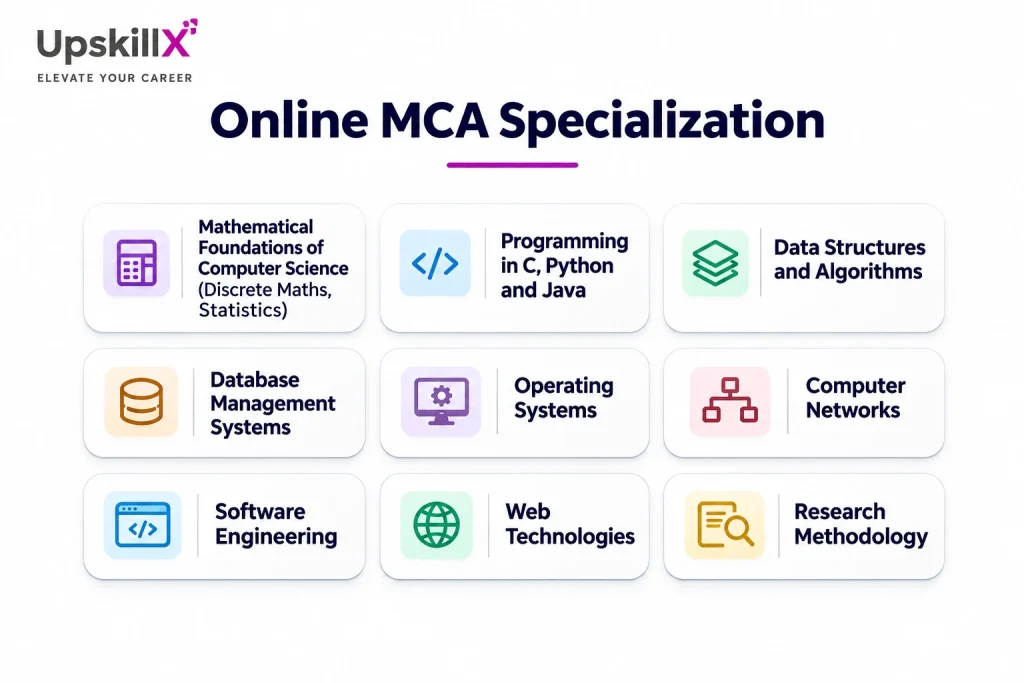
Common MCA subjects
These master of Computer Applications subjects appear in almost every programme, whatever specialisation you pick:
- Mathematical foundations of computer science (discrete maths, statistics)
- Programming in C, Python and Java
- Data structures and algorithms
- Database management systems
- Operating systems
- Computer networks
- Software engineering
- Web technologies
- Research methodology
A weak spot here will show later. Data structures and DBMS, in particular, underpin almost every specialisation.
Specialisation-specific subjects
| Specialisation | Core subjects in Year 2 |
| AI & Machine Learning | Foundations of ML, deep learning, natural language processing, computer vision, MLOps |
| Data Science / Analytics | Statistical modelling, data mining, big data analytics, data visualisation, predictive analytics |
| Cyber Security | Network security, cryptography, ethical hacking, digital forensics, cyber law |
| Cloud Computing & DevOps | Cloud infrastructure, virtualisation, containers and Kubernetes, CI/CD, cloud security |
| Full Stack Development | React or Angular, Node.js, REST APIs, NoSQL databases, deployment |
| Software Engineering | Software architecture, testing and QA, agile project management, design patterns |
| Blockchain Technology | Distributed ledger tech, smart contracts, cryptocurrency systems, blockchain security |
| FinTech & AI | Digital payments, financial data analytics, AI in banking, regulatory tech |
| Generative & Agentic AI | Transformer models, LLM fine-tuning, prompt engineering, building AI agents |
These sit on top of the core master of computer application subjects, not in place of them. Exact names vary by university, so always check the detailed syllabus before you apply.
Practical components and projects
Practical work is where online MCA programmes differ most in quality. Look for:
- Virtual labs for coding, cloud and security practice, accessible from home
- Mini projects in semester 2 or 3 that apply core subjects
- A capstone or major project in semester 4, usually in your specialisation
- Industry certifications built into the programme, for example cloud or security credentials
- Case studies and hackathons that simulate real work problems
The final project often ends up as the strongest item on your resume. Pick a topic you can show to an interviewer, such as a working app, a trained model or a security audit report.
How Do Online MCA Programmes Differ Across Universities?
The degree title is the same everywhere, but the specialisations, the depth of the curriculum and the industry partnerships vary a lot. Put the MCA specialization list of three popular providers side by side, and the range becomes obvious.
Specialisation availability
| University | Specialisations offered | Notable feature |
| JAIN Online | AI & ML, Data Science & AI, Cyber Security & AI, Cloud & DevOps, Full Stack Development, FinTech & AI, Generative & Agentic AI, Computer Science & IT | Widest range, including newer GenAI tracks |
| Amity Online | ML & AI, Cyber Security, Software Engineering, Blockchain Technology & Management, FinTech & AI | Industry-linked tracks with HCLTech, TCS iON and Paytm |
| Online Manipal (MUJ) | AI & Data Science, AI & ML, Cloud Computing, Cyber Security | Focused list of core, high-demand tracks |
Lists are taken from university and education-portal pages as of late 2026. Offerings change between intakes, so confirm on the official site.
Subject and curriculum differences
Two programmes with the same specialisation name can teach quite different content. One “Data Science” track may lean heavily on statistics and R, while another focuses on Python, big data and business dashboards. Check three things in the syllabus:
- How many subjects are truly specialisation-specific. Four to six is solid. One or two means it is a general MCA with a label.
- Which tools are taught by name, such as TensorFlow, AWS, Kubernetes or Power BI. Named tools signal a current curriculum.
- When specialisation subjects begin. Some start in semester 2, others only in semester 3.
Electives offered by universities
Electives let you add a second skill alongside your main track, for example, cloud computing alongside data science. Universities differ in:
- Number of electives, from one or two up to a full basket each semester
- Open versus restricted choice: some let you pick from any track, others limit you to your own
- Industry-designed electives delivered with tech partners, often with a certificate
- Soft-skill and research electives, such as research methodology or professional communication
A programme with flexible electives suits you if you want a hybrid profile, like data science with security, or full stack with cloud.
Factors to Consider When Selecting an MCA Specialisation
The right MCA specialization is the one that matches the job you want in two to three years, not just whatever is trending today. With so many specialization courses in MCA on offer, it’s easy to choose on hype alone. Work through these factors in order instead.
- Your target role. Start from the job title and work backwards. Want to be a data analyst? Pick data science. Aiming for SOC or security analyst roles? Pick cybersecurity.
- Your current background. A BCA graduate with coding experience can handle full stack or AI & ML from day one. A BCom or BSc graduate may find data analytics or FinTech an easier bridge.
- Your comfort with maths. AI, ML and data science rely heavily on statistics, linear algebra and probability. Cloud, full stack, and software engineering lean more on hands-on building.
- Demand where you want to work. Search job portals in your target city for each specialisation and compare the number of openings and required skills.
- Your work experience. Working professionals get the most out of a track that builds on their current role, for example, a support engineer moving into cloud or DevOps.
- Curriculum depth. Choose the programme with more specialisation-specific subjects and named tools, not only the more appealing title.
- Industry tie-ups and certifications. Partner-designed tracks and built-in certifications add proof of skills that recruiters recognise.
- Recognition of the university. Confirm the programme is UGC-entitled for online delivery and check the university’s NAAC grade. Without this, the specialisation is worth little.
One caution: niche tracks like blockchain or AR/VR can be valuable, but they offer fewer openings than AI, data, or cloud. Choose them only if you are genuinely drawn to that field.