

A PG course (postgraduate course), the next level of study after you complete your graduation (bachelor’s degree). It can be a master’s degree like M.A., M.Com., MBA or MCA, or a PG diploma in a focused area like digital marketing or HR.
In a PG course, you go much deeper into one subject than you did in your bachelor’s degree. You learn advanced concepts, real-world applications, research methods and specialised skills. Many courses also include projects, internships or a dissertation.
This article keeps it simple. You’ll learn the PG full form, see a clear list of postgraduate courses by stream, and find the best PG courses after B.Com, BA and BCA. If you’re already working, we explain online and distance PG courses, including online MBA, Executive MBA, online PGDM and online MCA, and how to check they’re valid. We also cover 1-year PG courses, eligibility, fees and a step-by-step way to choose the right course.
What Is the Full Form of PG?
In education, the full form of PG is Postgraduate.
“Post” means after, and a “graduate” is someone who has completed a bachelor’s degree. So a postgraduate is a student who is studying after graduation. That is why the order of study in India is: Class 12th → UG (graduation) → PG (post-graduation) → PhD.
You will see “PG” in many places after graduation:
- Admission forms: “PG programs” means master’s degrees and PG diplomas.
- Entrance exams: CUET PG and NEET PG are exams for PG admission.
- Job ads: “PG: Any Postgraduate” means the job needs a master’s degree in any subject.
One quick note: outside education, “PG” also means Paying Guest, a type of shared accommodation. If you are searching for PG courses, you need the education meaning: Postgraduate.
What Is a PG Degree?
A PG degree is a mastecr’s degree, such as an M.A., M.Com., M.Sc., MBA or MCA. It is the next level of study after your bachelor’s degree, and it prepares you for senior roles, college teaching, research or a PhD.
What Will You Learn in a PG Degree?
A PG degree goes much deeper into one subject than your bachelor’s degree did. You study advanced concepts, choose a specialisation such as Finance, Marketing, Data Science or English Literature, and build practical skills through case studies, projects and internships. Many PG degrees also include a dissertation or research project, which prepares you for a PhD later.
How Long Does a PG Degree Take?
Under the UGC (Minimum Standards of Instruction for the Grant of Undergraduate Degree and Postgraduate Degree) Regulations, 2025, the duration depends on your bachelor’s degree:
| Your bachelor’s degree | PG duration |
| 3-year degree (B.A., B.Com., B.Sc., BBA, BCA) | 2 years |
| 4-year degree with Honours or Honours with Research | 1 year |
Alongside PG degrees, there are also PG diplomas, shorter job-focused programs that usually last one year. We compare the two later in this article.
What Are Postgraduate Courses After Graduation?
Here is a simple PG courses list, grouped by field. Durations are for students with a 3-year bachelor’s degree.
PG Courses in Management
The main PG courses in management are the MBA, the PGDM, and the Executive MBA. An MBA is a university degree, a PGDM is a diploma from an AICTE-approved business school, and an Executive MBA is for people who already have several years of work experience. All three are open to graduates from any stream.
| Course | Full form | Duration | Good for |
| MBA | Master of Business Administration | 2 years | Managers, team leads, business roles in any sector |
| PGDM | Post Graduate Diploma in Management | 2 years | Industry-focused management roles, offered by AICTE-approved institutes |
| Executive MBA | Executive Master of Business Administration | 1-2 years | Experienced professionals moving into leadership |
You Can Also Read:
- Online MBA in India: Fees, Eligibility, Universities & How to Choose the Right One
- Best Online MBA Universities in India: Top Universities, Courses & Fees
PG Courses in Commerce and Finance
The main PG courses in commerce and finance are M.Com., MBA in Finance and specialised master’s degrees in finance and accounting. M.Com. is best for accounting, taxation, and teaching, while an MBA in Finance leads to banking, investment, and corporate finance roles.
| Course | Full form | Duration | Good for |
| M.Com. | Master of Commerce | 2 years | Accounting, taxation, teaching commerce |
| MBA (Finance) | MBA with Finance specialisation | 2 years | Banking, investment, corporate finance |
| MFA / M.Fin | Master of Finance and Accounting / Master of Finance | 2 years | Financial analysis and planning |
PG Courses in Science and Technology
The main PG courses in science and technology are M.Sc., M.Tech/M.E., MCA, and M.Pharm. M.Sc. suits research and teaching, M.Tech suits engineering specialists, MCA leads to software jobs, and M.Pharm leads to the pharma industry.
| Course | Full form | Duration | Good for |
| M.Sc. | Master of Science | 2 years | Research, teaching, labs, data and analytics |
| M.Tech / M.E. | Master of Technology / Engineering | 2 years | Specialised engineering roles, R&D |
| MCA | Master of Computer Applications | 2 years | Software development and IT careers |
| M.Pharm | Master of Pharmacy | 2 years | Pharma research and industry |
Professional UG degrees follow their own councils’ rules. B.Tech takes 4 years, B.Arch 5 years, and MBBS 5.5 years including internship.
PG Courses in Arts and Humanities
The main PG courses in arts and humanities are M.A., MJMC, MSW, and M.Des. M.A. is the widest choice, with subjects like English, History and Economics. MJMC leads to media jobs, MSW leads to social work, and M.Des. leads to design careers.
| Course | Full form | Duration | Good for |
| M.A. | Master of Arts | 2 years | English, History, Economics, Political Science, Sociology and more |
| MJMC | Master of Journalism and Mass Communication | 2 years | Media, news, digital content |
| MSW | Master of Social Work | 2 years | NGOs, CSR, community development |
| M.Des. | Master of Design | 2 years | Product, UX, fashion and communication design |
PG Courses in Law, Education and Medicine
The main PG courses in law, education and medicine are LLM (law), M.Ed. (education) and MD/MS (medicine). Each needs a specific bachelor’s degree first: an LLB for an LLM, a B.Ed. for an M.Ed., and an MBBS for an MD or MS, which you enter through NEET PG.
| Course | Full form | Duration | Good for |
| LLM | Master of Laws | 1-2 years | Specialised legal practice and teaching (after an LLB) |
| M.Ed. | Master of Education | 2 years | Senior teaching and education roles (after a B.Ed.) |
| MD / MS | Doctor of Medicine / Master of Surgery | 3 years | Medical specialisation (after MBBS, through NEET PG) |
What Are the Popular PG Diploma Courses?
PG diploma courses are shorter and more job-focused. Popular ones include PG Diploma in Digital Marketing, Data Science, Human Resource Management, Financial Management, Journalism, Cyber Security and Hospital Administration. Most take 1 year and are ideal if you want a quick skill upgrade without a full master’s degree.
Which Courses Can You Pursue After Graduation?
Your bachelor’s subject doesn’t lock you in, but it does make some courses after graduation a more natural fit.
Best PG Courses After B.Com
- M.Com.: Best if you love accounts and taxation or want to teach commerce.
- MBA (Finance, Marketing or HR): Best for corporate and banking careers.
- CA, CS or CMA: Professional qualifications that many B.Com graduates pursue.
- PG diploma in Banking, Taxation or Financial Analytics: A 1-year skill boost.
Best PG Courses After BA
- M.A.: Go deeper into your subject for teaching, research or civil services.
- MBA: Open to graduates from any stream; a popular switch into business roles.
- MJMC or MSW: For media careers or social-sector work.
- B.Ed. followed by M.Ed.: For a career in school teaching.
- LLB: A 3-year law degree you can join after any graduation.
You Can Also Read:
- Top MBA Courses Online: Specializations, Skills, and Career Options
- Online MCA Course: Eligibility, Fees, Syllabus, Admission & Career Scope
Best PG Courses After BCA
- MCA: The natural next step for software and IT roles.
- M.Sc. Computer Science or Data Science: For tech roles with a stronger maths and research side.
- MBA (IT or Business Analytics): For moving into tech management.
- PG diploma in Cyber Security, Cloud Computing or AI: For fast, job-focused skills.
An example: Rohit finished his BCA and took a support job at an IT company. He wanted to become a developer but couldn’t afford to quit. He enrolled in an approved online MCA, studied on weekends, and moved into a developer role before he even graduated.
What Are the Best PG Courses for Working Professionals?
Yes. Online PG courses are built for working professionals who want a promotion, a career switch or a higher salary without leaving their job. Classes happen in the evenings or on weekends, lectures are recorded, and exams are taken online.
Are online postgraduate courses valid? Yes, if they come from an approved university. UGC treats PG degrees and PG diplomas earned in online or distance mode from recognised institutions as equivalent to those earned on campus, under Regulation 22 of its Open and Distance Learning and Online Programmes Regulations (UGC Regulations).
Before you enroll, run three quick checks:
- The awarding body: The degree must come from the university itself. Affiliated colleges are not allowed to run online programs.
- UGC-DEB approval: The university must be approved for that exact program and academic year on the UGC-DEB website.
- AICTE approval for MBA, MCA and PGDM: These are technical and management programs, so they also need approval from AICTE.
What Are the Types of Online PG Courses in India?
Most online PG courses for working professionals fall into seven types. Here’s what each one is and who it suits.
Online MBA
An online MBA is a full 2-year master’s degree delivered through live online classes, recorded lectures and online exams. It covers the same core subjects as a campus MBA: finance, marketing, HR, operations and strategy.
- Best for: Employees with a few years of experience who want to move into management
- Popular specialisations: Finance, Marketing, HR, Business Analytics, Operations, IT
- Weekly time: About 10-15 hours
One-Year MBA
A one-year MBA compresses the program into 12 months. In India, it usually means one of two things:
- A full-time campus program at top business schools, such as the IIMs’ one-year programs for experienced professionals, which usually require several years of work experience
- A 1-year master’s for students who hold a 4-year bachelor’s degree with Honours, as allowed under UGC’s 2025 rules
Be careful with ads for a “1-year online MBA.” Some are foreign degrees or certificates rather than Indian MBA degrees, so check exactly what you will receive before paying.
Executive MBA
An Executive MBA (EMBA) is designed for mid-level and senior professionals, usually with 5 or more years of experience. Classes are on weekends, online, or in short campus visits, and teaching uses real business cases. Your classmates are experienced managers, so the networking is as valuable as the coursework.
- Best for: Managers aiming for leadership and senior roles
- Duration: Usually 1 to 2 years
Distance MBA
A distance MBA is the most affordable option. You mainly study from printed or digital study material, attend a few contact classes at study centres, and write exams at test centres. There is less live teaching than in an online MBA, so you need strong self-discipline.
- Best for: Learners on a tight budget or with irregular work hours
- Duration: 2 years
Online PGDM
A PGDM (Post Graduate Diploma in Management) is offered by AICTE-approved standalone business schools rather than universities. Its syllabus is often updated faster to match industry needs. An online PGDM delivers the same program online and also needs AICTE approval for online mode.
- Best for: Professionals who want an industry-focused management qualification
- Duration: 2 years

Executive PGDM
An Executive PGDM is the business-school version of an Executive MBA. It is offered by AICTE-approved institutes for experienced professionals, usually in weekend, blended or online formats.
- Best for: Working managers who prefer a business-school program over a university degree
- Duration: Usually 1 to 2 years
Online MCA
An online MCA (Master of Computer Applications) is a 2-year PG degree for IT careers. It covers advanced programming, data structures, databases, cloud computing, AI and software engineering.
- Best for: BCA and B.Sc. graduates, or graduates who studied Maths, moving into software roles
- Popular specialisations: Data Science, Cloud Computing, Cyber Security, AI and Machine Learning
- Tip: Choose a program with live coding labs and real projects, not just recorded videos.
Which Online PG Course Is Right for You?
The right online PG course depends on your goal and experience. Choose an online MBA to move into management, an Executive MBA or Executive PGDM if you already have 5+ years of experience, a distance MBA if cost matters most, and an online MCA for IT careers. The table below compares all seven side by side.
| Program | Duration | Work experience | Mode | Best for |
| Online MBA | 2 years | Not always required | Online | Moving into management |
| One-year MBA | 1 year | Often several years (campus) | Mostly campus | Fast-track career growth |
| Executive MBA | 1-2 years | Usually 5+ years | Weekend, blended or online | Leadership roles |
| Distance MBA | 2 years | Not required | Study material + contact classes | Lowest cost |
| Online PGDM | 2 years | Varies | Online | Industry-focused management |
| Executive PGDM | 1-2 years | Usually required | Weekend, blended or online | Experienced managers |
| Online MCA | 2 years | Not required | Online | IT and software careers |
What Are the 1-Year PG Courses in India?
If you want to finish your post-graduation quickly, India offers a few solid 1-year PG options. The most important is the 1-year master’s degree. Under UGC’s 2025 rules, students who hold a 4-year bachelor’s degree with Honours can complete a master’s such as an M.A., M.Com. or M.Sc. in just one year, instead of the usual two.
PG diploma courses are another popular route. Most last one year and focus on job-ready skills in areas like digital marketing, data science, human resources or finance, which makes them a good choice if you want to upgrade your skills or switch careers quickly. Law graduates can also choose a 1-year LLM to specialise in a particular area of law.
For experienced professionals, one-year MBA and executive programs offer a fast-track path into leadership roles, as explained in the section above.
The trade-off with any 1-year course is a heavier workload. A full year’s worth of learning is packed into a shorter time, so if you are also working, plan your weekly study hours carefully before you enrol.
What Is the Difference Between a PG Degree and a PG Diploma?
Both come after graduation, but they serve different goals.
| PG degree | PG diploma | |
| Examples | M.A., M.Com., M.Sc., MBA, MCA | PGDM, PG Diploma in Digital Marketing, HR, Data Science |
| Awarded by | Universities | Universities or AICTE-approved institutes |
| Duration | 1-2 years | Usually 1 year (PGDM is 2 years) |
| Focus | Deep subject knowledge plus some practical skills | Practical, job-ready skills |
| Fees | Moderate to high | Usually lower (except top PGDMs) |
| Further study | Leads directly to PhD, teaching and NET | May not qualify for PhD or teaching posts on its own |
| Best for | Academic careers, government jobs, long-term growth | Quick skill upgrades and career switches |
What about PGDM vs MBA?
A PGDM from a well-known AICTE-approved business school is highly valued by employers, and its syllabus is often more industry-focused. An MBA is a university degree. If you may later apply for a PhD, a teaching post or a government job that asks for a master’s degree, an MBA is the safer choice, or check that your PGDM has been granted MBA equivalence.
Simple rule: Choose a PG degree if you want long-term academic or government options. Choose a PG diploma if you need specific skills quickly.
What Is the Difference Between Online and Distance PG Courses?
Online and distance PG courses both let you study without attending college every day, but they work very differently.
| Online PG course | Distance PG course | |
| How you learn | Live classes, recorded lectures, digital platform | Mainly self-study from study material |
| Teacher contact | Regular, through live sessions and forums | Limited, through occasional contact classes |
| Exams | Usually online, remotely proctored | Usually at exam centres |
| Fees | Moderate | Lowest |
| Discipline needed | Medium | High |
| Best for | Working professionals who want guidance and interaction | Self-motivated learners on a tight budget |
In value, there’s no difference between the two: both carry the same weight as a campus degree, as long as the university passes the approval checks explained earlier.
Simple rule: If you want structure and live teaching, choose online. If you can study on your own and want to save money, distance PG courses are a good fit.
What Is the Eligibility for PG Courses?
Basic eligibility: You need a bachelor’s degree from a recognised university, usually with at least 45-50% marks, with relaxation for reserved categories. Some courses need a related degree, such as an LLB for an LLM or Maths in graduation for MCA.
Entrance exams for campus programs:
- MBA/PGDM: CAT, XAT, MAT, CMAT and similar exams
- Central university PG programs: CUET PG, conducted by the National Testing Agency
- M.Tech: GATE
- MD/MS: NEET PG
Online and distance PG courses: Most offer direct admission based on graduation marks, sometimes with a short interview. Executive MBA and Executive PGDM programs usually also ask for several years of work experience.
What Are the Fees and Duration of PG Courses?
The figures below are rough, indicative ranges for the full course. Fees change every year, so always check the latest fee page on the university’s own website.
| Course | Duration | Approx. fees (full course) |
| M.A., M.Com., M.Sc. (government college) | 2 years | Often under ₹50,000 |
| M.A., M.Com., M.Sc. (private college) | 2 years | ₹1 lakh to ₹4 lakh |
| Campus MBA / PGDM | 2 years | ₹3 lakh to ₹25 lakh or more at top B-schools |
| Online or distance MBA | 2 years | Often ₹50,000 to ₹3 lakh |
| Executive MBA / Executive PGDM | 1-2 years | ₹2 lakh to ₹30 lakh or more |
| MCA (campus) | 2 years | ₹1 lakh to ₹5 lakh |
| Online MCA | 2 years | Often ₹80,000 to ₹2.5 lakh |
| PG diploma courses | 1 year | Often ₹20,000 to ₹2 lakh |
For campus courses, add hostel, travel and study costs. Many online programs offer EMI options, and some employers reimburse fees for job-related PG courses, so ask your HR team.
How to Choose the Right PG Course After Graduation?
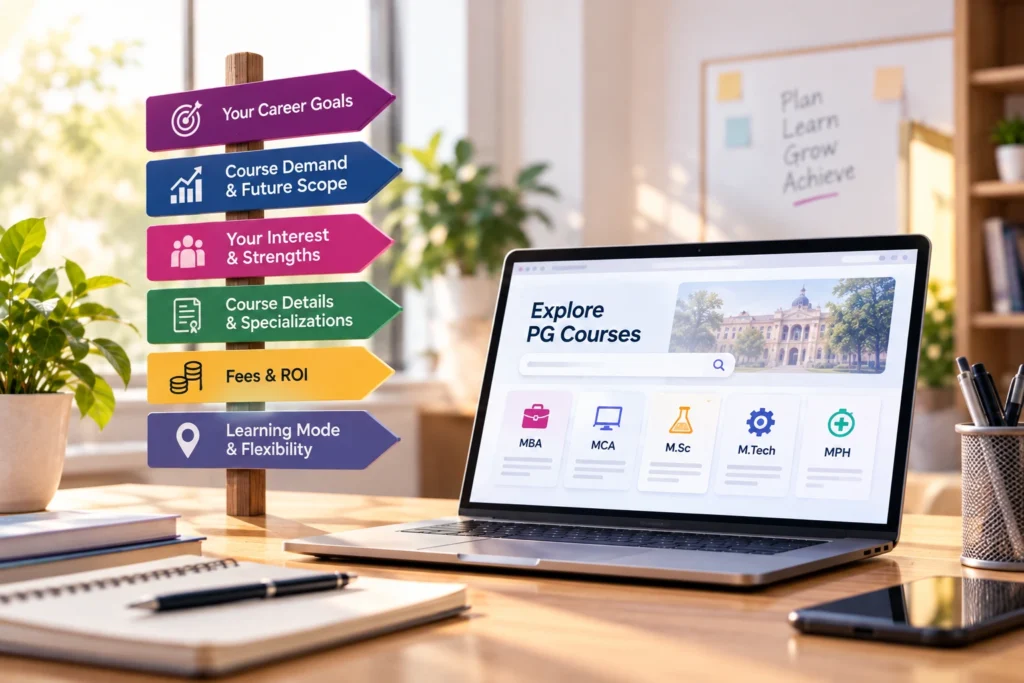
The right PG course is the one that moves you towards a clear goal. Use these five steps:
- Decide what you want the PG course to do for you. A promotion, a career switch, a teaching job, a government job or a PhD all point to different courses. Write your goal down first.
- Match the course to the goal. Want to manage teams? Look at an MBA or PGDM. Want to teach or research? Choose an M.A., M.Com. or M.Sc. Want a quick skill upgrade? A PG diploma may be enough.
- Pick a mode that fits your life. If you can take two years off, a campus program gives the most networking. If you’re working, an online or distance PG course lets you keep earning.
- Check the institution, not just the course. Run the approval checks from the online section, and make sure the university is not on UGC’s fake universities list. Then compare faculty, placements, alumni and NAAC grades.
- Be realistic about time and money. Online courses need 10-15 hours a week. Add up the full fees and extra costs, and check whether your employer offers sponsorship.
An example: Neha had five years of experience in sales and wanted to become a regional manager. A campus MBA meant losing two years of salary, so she chose an Executive MBA with weekend classes instead. Her company sponsored part of the fee, and she was promoted in her second year.
Still unsure? Talk to people already working in the role you want and ask which qualification actually helped them.