
Maybe you’re working full-time and can’t quit college. Maybe you’re preparing for UPSC or SSC and need a degree on the side. Or maybe the nearest good university is hours away. Whatever your reason, an online degree in India can get you a recognised qualification without changing your life around it.
The catch is that the online education market is crowded, and not every offer is genuine. Choosing the wrong program can cost you years and lakhs of rupees.
This article walks you through it step by step: how online degree courses actually work, how to confirm one is valid, which online graduation and master’s degrees are worth your time, what they cost, how employers see them, and the traps to avoid before you pay.
What Are Online Degrees?
Online degree courses are full university degrees, such as a BA, B.Com., BBA, BCA, MBA or MCA, that you complete entirely over the internet. There is no campus to attend. You log in to the university’s learning platform, attend classes there, submit work there and take your exams there or at a nearby centre. When you finish, the university awards you a bachelor’s or master’s degree
Curious What an Online Class Looks Like? A Typical Week
Most programs follow a weekly rhythm built around a working person’s schedule:
- 2-3 live sessions of about 60-90 minutes, usually on weekday evenings or weekends
- Recorded lectures for every topic, which you can pause, rewatch and study at your own pace
- Reading material such as e-books, slides and case studies
- A short quiz or assignment to check what you learned that week
- Discussion forums and doubt sessions where faculty answer questions
In total, plan for 10-15 hours of study a week, a little more just before exams.
Worried About Online Exams? How They’re Conducted
Most universities hold remotely proctored exams: you take the test on your laptop at home while your webcam, microphone and screen are monitored, and your ID is verified before you start. Some universities hold exams at test centres instead. Either way, your final marks usually combine the semester-end exam with internal assessment from assignments and quizzes, so steady work through the semester pays off.
Are Online Degrees Valid in India?
An online degree counts as much as a regular one, provided the university is entitled by UGC to offer that program online. Regulation 22 of the UGC (Open and Distance Learning Programmes and Online Programmes) Regulations, 2020 states that UG and PG degrees earned online from such universities are equivalent to degrees earned through regular, on-campus study (UGC Regulations). That equivalence is what makes them acceptable for jobs, competitive exams and higher studies.
Confused by “UGC-Approved” Claims? What Accredited Really Means
Many ads say “UGC-approved” or “UGC-recognised,” but that alone isn’t enough. A university can be UGC-recognised for campus programs without being allowed to run online ones. For an online degree, look for:
- UGC-DEB entitlement for your exact program and academic session
- AICTE approval if it is an MBA, MCA or another management or technical program (AICTE)
- A strong NAAC grade or NIRF rank, since UGC generally allows only high-quality universities to offer online degrees
UGC also bars entitled universities from running online programs through franchise arrangements, so the university itself must own and deliver the program.
Not Sure a University Is Genuine? Check It in 3 Minutes
- Open the official UGC-DEB website.
- Go to Recognised Programmes, then OL, then Entitled.
- Find the university and confirm your exact program is listed for the current session.
- Cross-check that it isn’t on UGC’s fake universities list.
Planning Psychology or Engineering Online? Read This First
Some subjects simply aren’t allowed online. UGC prohibits online programs that need hands-on training, including engineering, medicine, dentistry, pharmacy, nursing, architecture, physiotherapy and law. Since the July-August 2025 session, it has also stopped online and distance programs in psychology and other allied healthcare subjects, such as microbiology, food and nutrition science, and biotechnology. Any “online” version of these from an Indian university will not be valid. The full list of prohibited programs is on the DEB website.
You Can Also Read:
- Online Certificates vs Online Degrees: What Delivers Faster Career ROI?
- How to Choose the Right Online Program Without Falling for Marketing Hype
Online, Distance or Regular? Find the Mode That Fits Your Life
All three modes can lead to a valid degree. What really changes is how much teaching support you get, how fixed your schedule is, and how much you spend.
| Online degree | Distance degree | Regular degree | |
| How you learn | Live and recorded classes on a digital platform | Mostly self-study from printed or digital material | Daily classes on campus |
| Teacher contact | Regular, through live sessions and forums | Limited, through occasional contact classes | Daily, face to face |
| Exams | Online proctored or at test centres | At exam centres | On campus |
| Schedule | Flexible, with some fixed live classes | Fully flexible | Fixed timetable |
| Cost | Moderate | Lowest | Highest, plus hostel and travel |
| Campus life | Online events only | None | Full campus experience |
Simple rule: Choose regular if you can study full-time and want campus life. Choose online if you want flexibility but still value live teaching. Choose distance if you’re highly self-motivated and want to spend as little as possible.
You don’t always have to pick just one. UGC allows students to pursue two degrees at the same time, such as a regular degree alongside an online one, which lets you add a second qualification without adding extra years.
What Can You Actually Study Online? UG, PG and PhD Options
Your starting point decides your level. If you’ve just finished Class 12th, you’re looking at an online graduation degree. If you already have a bachelor’s degree, an online master’s is the next step. If you only need one specific skill, a PG diploma or certificate may be enough.

Just Finished Class 12th? Online Graduation Degrees to Consider
| Degree | What you study | Best for |
| Online BA | English, History, Political Science, Economics, Sociology and more | Government exam aspirants, future teachers, humanities lovers |
| Online B.Com. | Accounting, taxation, GST, business law, finance | Accounts and banking jobs, CA/CS/CMA aspirants |
| Online BBA | Management, marketing, HR, finance, entrepreneurship | Future managers and business owners |
| Online BCA | Programming, databases, web development, networking | IT and software careers |
A few universities also offer an online B.Sc. in subjects like Mathematics or Data Science.
Already a Graduate? Online Master’s Degrees Worth Your Time
Online master’s degrees, also known as online graduate degrees in the US, are the most popular choice among working professionals.
| Degree | What you study | Best for |
| Online MBA | Finance, marketing, HR, operations, business analytics | Moving into management roles |
| Online MCA | Advanced programming, cloud computing, AI, data science | Senior IT and software roles |
| Online M.Com. | Advanced accounting, taxation, financial management | Finance careers and teaching commerce |
| Online MA | English, Economics, Political Science, Sociology and more | Teaching, research, civil services |
| Online M.Sc. | Mathematics, Data Science and similar subjects | Analytics and academic roles |
Need a Quick Skill Boost? Online PG Diplomas and Certificates
If you don’t need a full degree, a 1-year online PG diploma or a short certificate in areas like digital marketing, data science, HR or financial management can upgrade your skills quickly and cheaply. Keep in mind that a PG diploma is not a master’s degree, so on its own it won’t qualify you for PhD admission or college teaching.
There’s also SWAYAM, the government’s free online course platform. Under UGC’s credit framework, universities can count SWAYAM courses towards part of your degree credits, which can lighten your semester load.
Hoping for an Online PhD? What You Need to Know
A fully online PhD is not recognised in India. Under UGC’s PhD Regulations, 2022, a PhD must be done in regular or part-time mode at a recognised university, with coursework and a supervisor. UGC and AICTE have publicly warned students against online PhDs sold by edtech companies with foreign institutions. If you’re working and want a doctorate, a part-time PhD at a UGC-recognised university is the valid route.
You Can Also Read:
- What Are PG Courses After Graduation? Full Form, List & Online Options (2027)
- UG Courses: Full Form, List of Undergraduate Courses After 12th & Online Options (2027)
- Doctorate Degree 2027: Types, Online Doctoral Programs, Eligibility and Recognition
Want the Best Return? Online Degrees in Demand in 2027
If career growth is your main goal, these four online degrees lead to roles that employers are actively hiring for:
- Online MBA: Leads to roles like business analyst, marketing manager, HR manager and operations lead. It is especially valuable once you already have a few years of work experience.
- Online MCA: Opens doors to software developer, data analyst and cloud associate roles. Specialisations in AI, Data Science or Cloud add the most value right now.
- Online B.Com.: Leads to accounts executive, GST and tax assistant, and banking roles, and pairs well with CA or CMA preparation.
- Online BA: The most practical base for UPSC, SSC and state civil service preparation, because it frees up the most time for exam study.
Working, Preparing for Exams or Far From College? Online Might Fit You
An online degree makes the most sense when your circumstances make regular college hard. It’s a strong fit if you are:
- A working professional who needs a qualification for a promotion or a career switch but can’t take a break from earning
- A competitive exam aspirant who needs graduation for eligibility but wants most of the day free for preparation
- Living in a small town without a good university nearby, or unable to relocate
- Running a family business or caring for family and needing to study around those responsibilities
- A student who missed a regular college seat and doesn’t want to lose a year
It’s usually not the best fit if you’re a fresher hoping for campus placements and student life, or if your dream course is one of the subjects that can’t be studied online.
On a Budget? What Online Degrees Really Cost in 2027
Online degrees are cheaper mainly because you skip hostel, travel and campus fees, and you can keep earning while you study. Here are indicative full-course fees by degree. Fees change every year, so always confirm on the university’s official fee page.
| Online degree | Approx. total fees |
| Online BA | ₹30,000 to ₹1.5 lakh |
| Online B.Com. | ₹40,000 to ₹1.8 lakh |
| Online BBA | ₹60,000 to ₹2.5 lakh |
| Online BCA | ₹60,000 to ₹2.5 lakh |
| Online MA / M.Com. | ₹30,000 to ₹1.5 lakh |
| Online MCA | ₹80,000 to ₹2.5 lakh |
| Online MBA | ₹60,000 to ₹3.5 lakh |
Looking for the Most Affordable Option? Start Here
The lowest fees are usually for the online BA, B.Com. and MA, especially at government and state open universities, where the total can be a fraction of what private universities charge. Private universities cost more but often include more live classes, career services and better learning platforms. Compare what’s included, not just the headline price.
Can’t Pay Upfront? EMIs, Scholarships and Employer Support
Most private universities let you pay semester-wise or through no-cost EMIs. Many offer fee waivers for defence personnel, government employees, differently-abled learners, alumni and merit students. If the degree is related to your job, ask HR whether your employer reimburses fees. Government scholarships are listed on the National Scholarship Portal.
Is an Online Degree Worth It? The Honest Pros and Cons
The online format has real strengths and real weaknesses. Knowing both helps you decide whether it suits the way you learn.
What Do You Gain With an Online Degree?
- Rewatchable lectures: Replay a difficult topic as many times as you need, something a live classroom can’t offer.
- Learning you can use immediately: Working students can apply concepts at their job the very next day.
- Digital skills: Online collaboration, presentations and digital tools become second nature, and most workplaces now expect them.
- A nationwide network: Your classmates come from different cities and industries, which widens your professional circle.
- Control over your pace: Within each semester, you decide when and how much to study each day.
What Do You Give Up?
- Built-in discipline: No one marks you absent, so staying on track is entirely your job.
- Face-to-face connections: Casual conversations with classmates and professors are harder to recreate online.
- Hands-on exposure: Internships and practical projects are fewer than in many campus programs.
- Consistent placement help: Career support ranges from strong to almost nothing, depending on the university.
- Tech independence: You need a reliable laptop and internet connection throughout the course.
Will an Online Degree Help You Get Hired? What Employers Think
An online degree helps your career when it fills a real gap, such as a missing graduation, a management qualification for a promotion, or a technical upgrade for a new role. Employers judge it mainly on the university’s reputation and the skills you can show.
Aiming for a Government Job? Here’s Where Online Degrees Stand
Most government job notifications ask for a degree “from a recognised university,” and a UGC-entitled online degree meets that condition. Exams like UPSC Civil Services, SSC CGL and bank PO only require graduation in any subject, which is why so many aspirants pick an online BA or B.Com. During document verification, keep your degree, mark sheets and a printout of your university’s UGC-DEB entitlement for your session ready, in case an official asks.
Applying to Private Companies? How Recruiters See Online Degrees
Recruiters care most about two things: whether the university is genuine, and whether you can do the job. An online MBA or MCA from a well-known university, backed by real work experience, often counts for more than a campus degree with none. Strengthen your profile with projects, certifications and a portfolio you can show in interviews.
Planning a Master’s, PhD or Study Abroad? What to Expect
In India, an entitled online bachelor’s degree makes you eligible for a master’s, and an online master’s makes you eligible for NET and PhD admission. Abroad, rules vary by country and university. Many foreign universities accept Indian online degrees, but some ask for a credential evaluation or treat online study differently, so check with each university before you apply.
Pick Your Online Degree? Follow These 6 Steps
A good decision comes down to matching the right degree to the right university. Work through these steps in order:
- Write down your goal. A promotion, a career switch, a government job or higher studies each point to a different degree.
- Choose your level and subject. Use the course tables above to shortlist two or three options that fit your goal.
- Verify approval. Run the 3-minute UGC-DEB check for every university on your list, and drop any that fail.
- Test the teaching. Ask how many live classes there are each week, and attend a demo class if one is offered.
- Talk to alumni. Find two or three graduates on LinkedIn and ask about support, exams and career outcomes.
- Compare the full cost. Add exam fees and any other charges to the tuition, and compare EMI options side by side.
An example: Arjun, a sales executive in Lucknow, wanted to move into marketing management. He shortlisted three online MBA programs and found during his check that one wasn’t entitled for the current session. He dropped it, attended demo classes at the other two, spoke to alumni, and chose the one with more live-class hours, all without leaving his job.
The Online Degree Admission Process, Step by Step
Applying takes less than an hour, and most programs need no entrance exam.
Who can apply:
- Online UG degree: Anyone who has passed Class 12th from a recognised board. Some courses ask for specific subjects or a minimum percentage.
- Online PG degree: Graduates from a recognised university, usually with 45-50% marks. Online MBA and MCA may have extra subject or percentage requirements.
How to apply:
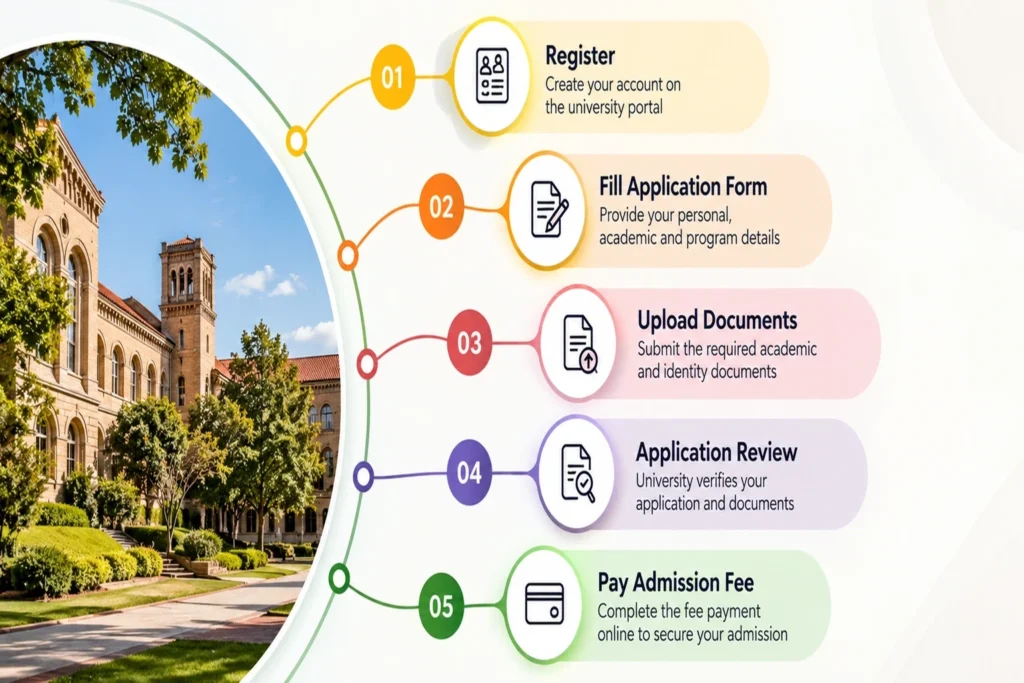
- Create your DEB ID on the UGC-DEB portal. It’s mandatory for every online and distance learner and stays valid for life.
- Fill in the application on the university’s official website, including your DEB ID.
- Upload documents, such as mark sheets, ID proof and a photograph.
- Pay the fee, in full, semester-wise or through EMI.
- Receive your enrolment number and login details for the learning platform.
Most universities admit students twice a year, in January-February and July-August, so you rarely have to wait long to start.
Mistakes to Avoid With Online Degrees
The biggest risks come from pressure and shortcuts. Watch out for these red flags:
- “Degree in 6 months” offers: Online UG and PG degrees take the same time as regular ones. A shortcut means a fake or invalid degree.
- Pressure tactics: “Only 2 seats left” or “50% off, today only” messages are meant to stop you from checking properly.
- Paying anyone except the university: Never pay fees in cash or into an agent’s personal account. Pay only through the university’s official payment page.
- Look-alike websites: Some sites copy a real university’s name and logo with a slightly different web address. Always reach the university through its official site.
- Skipping the fine print: Check exam centre locations, re-exam fees and refund rules before you pay.
- Copying a friend’s choice: The right degree is the one that matches your goal, not someone else’s.